
or
 Continue with Facebook
Looking to list your PhD opportunities? Log in here.

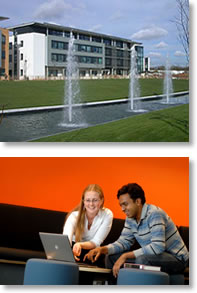 Warwick's Complexity Science Doctoral Training Centre is a ground-breaking, inter-disciplinary initiative aimed at training a new generation of scientists at PhD level to understand, control and design complex systems, and to do innovative research in complexity science via critical thinking, interdisciplinary teamwork and end-user interaction.
Complexity Science focusses on systems of many interdependent components, showing Emergent behaviour at the system level, Self-organisation and/or Evolution. Our Centre draws on aspects of these in existing fields, including mathematics from dynamical systems and chaos, physics of phase transitions, self-assembly in chemistry, network modelling in biology and neuroscience, interacting agent modelling in economics and computer science, statistical inference. We also look to apply scientific methods in new fields of opportunity, such as transport, health and social science applications where mass quantitative data is newly available in this information age.
 The Transferable Skills Programme is built on that of our sister MOAC Doctoral Training Centre, the latter considered to be a landmark success in this regard.
The Centre is led by a team of experienced Warwick professors, plus EPSRC and RCUK funded academic staff directly associated with it. The DTC is housed in a dedicated Centre along with our wider Complexity [research] Complex.
Applicants should hope to obtain a first class degree in a scientific, mathematical or analytical subject, and you need some natural orientation towards modelling problems in quantitative mathematical terms.
 Further details

or
Continue with Facebook