

This project is no longer listed on FindAPhD.com and may not be available.
Click here to search FindAPhD.com for PhD studentship opportunities
About the Project
Supervision:
Dr JP Latham, Dr Jiansheng Xiang
Industry Contacts:
Principal Investigator – Dr Michele Marigo
Co-investigators — Dr Mikael Carlsson, Prof Hugh Stitt
Applications are invited for a PhD studentship to join AMCG (Applied Modelling and Computational Group) in the Department of Earth Science & Engineering.
Imperial College London (ICL), Earth Science and Engineering Department, has developed a 3D code based on the combined Finite-Discrete Element Method (FEMDEM), see VGeST.net. These codes allow not only particle flows to be simulated for moving particles (the DEM part) but they also allow detailed stress calculations to be undertaken on any complex particle shapes and complex structures (such as packed beds) by meshing the interior of the solid (the FEM part). This code therefore offers the prospect in the long term of simulating stresses and fracture during loading of cylindrical and other sophisticated shapes - such as might be developed and optimized for catalyst pellets in Johnson Matthey’s production processes.
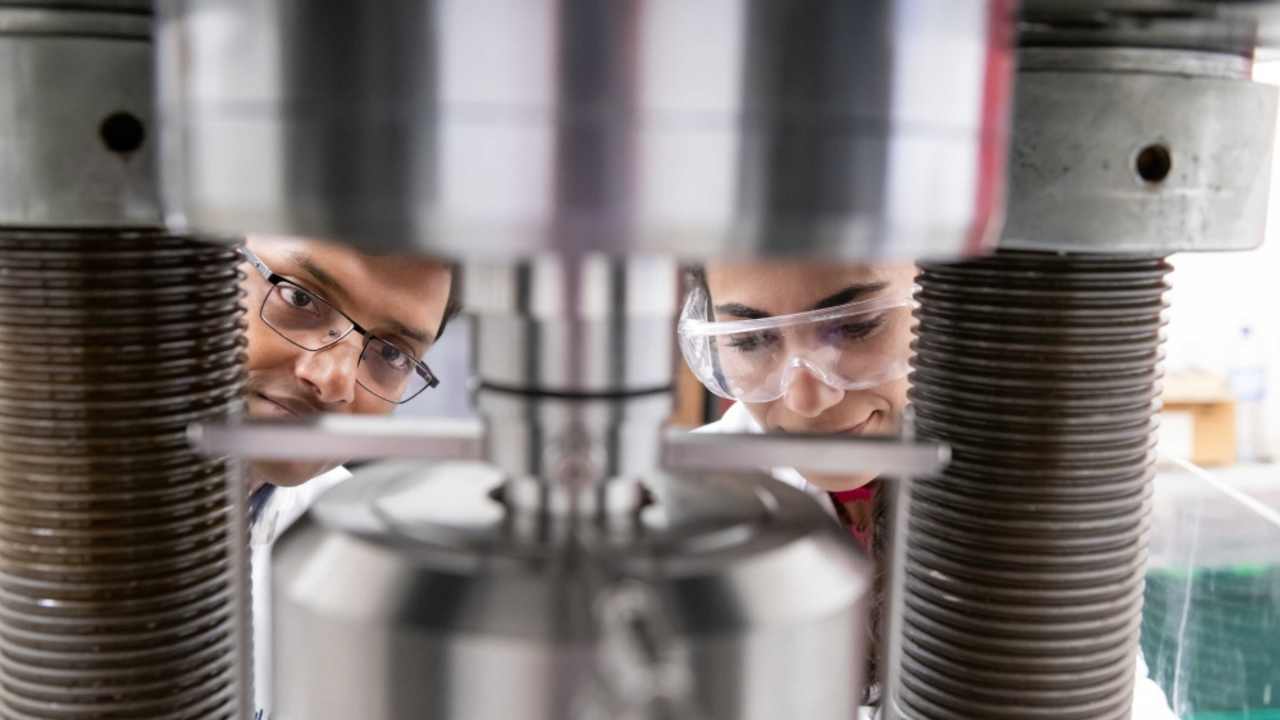
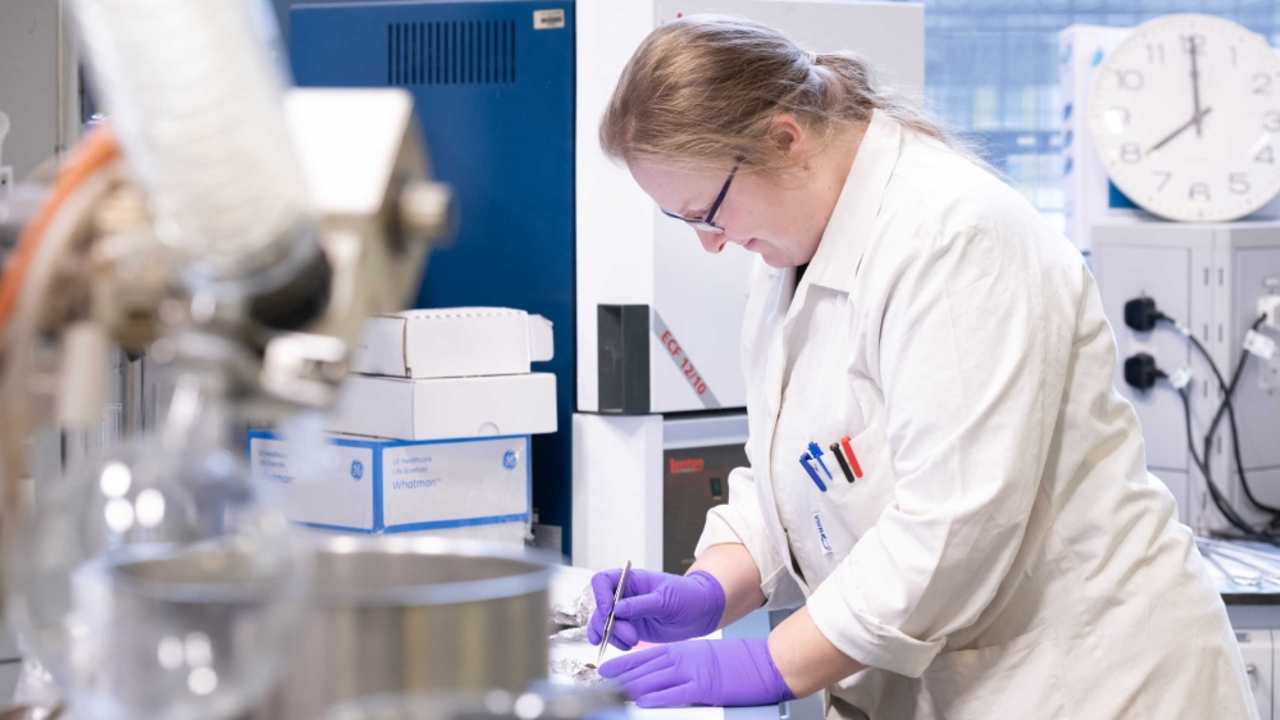
This studentship links JM’s future needs with Imperial’s excellence award winning AMCG research group. Implementing fracture in the 3D multi-body FEMDEM code that is capable of capturing packing processes with great accuracy is still very much a “work in progress” and this project will develop and validate certain aspects of the code that are relevant to JM’s interests. For example, the research will reveal how force and stress chains form within packed beds or packed tubes and how different pellet shapes and strengths contribute to improved catalyst performance. The student will also have a unique opportunity to work at JM’s laboratories on pellet preparation as well as strength and fracture studies to validate existing 2D models and support the development and validation of the 3D fracture models. The aim would be to compare laboratory measurements at JM with the equivalent FEMDEM models to examine particle stresses and fractures e.g. in a system with a small number of particles in a tubular container. The PhD may emphasise code developments or results interpretation or be a balance between the two.
The Candidate: Successful candidates will join, and be supported by, a dynamic research group with world-class expertise in modelling. The candidate will have the opportunity to develop their career and profile by presenting at international conferences in numerical and applied fields and publishing in high impact journals. Candidates should have a good mathematical mbackground and a good degree/diploma in an appropriate field such as earth science, physics, mathematics, mechanical, civil or materials engineering. Experience of research relevant to the mechanics of fracture will be an advantage. Good written and spoken communication skills are essential. For further information please see our website: www.ese.ic.ac.uk.
Application forms and instructions to send CVs, references etc can be obtained from our website:
(http://www3.imperial.ac.uk/earthscienceandengineering/courses/phdopportunities/phdapplicationprocedure)
or from Ms Samantha Delamaine (E-mail: [Email Address Removed], Tel: +44 (0) 207 594 7339). Further information about the project can be obtained from John-Paul Latham ([Email Address Removed]). Interviews are planned for January and applications are accepted until the post is filled. An early start date is preferred.
Consistently rated amongst the world's best universities, Imperial College London is a science based institution with a reputation for excellence in teaching and research. Committed to equality and valuing diversity. We are also an Athena Silver SWAN Award winner and a Stonewall Diversity Champion.
Funding Notes
Hidden from site as requested by supervisor, deadline has passed 26/09/2013 DS.

Project supervisors
Career overview
Dr John-Paul Latham holds a PhD in Structural Geology from Imperial College London. He began his academic career at Queen Mary University, where he became the Director of the MSc in Geomaterials. In 1999, he returned to Imperial College as a Reader in Geomechanics within the Department of Earth Science and Engineering. Dr Latham''s primary research interests encompass rock engineering, geomechanics, geological structures, and coastal engineering structures. He has been a proponent of using numerical models based on the combined finite-discrete element method (FEMDEM or FDEM) for over two decades. The modelling platform initiated by Dr Latham and Munjiza during their EPSRC project, ‘VGW’ or Virtual Geoscience Workbench, from 2004 to 2009, was relaunched in 2016 as Solidity. This software platform includes features such as fracture initiation, propagation, fragmentation, and fracture network development, and has been extended to incorporate rock microstructures, two-way fluid coupling, thermal cracking, and large plastic deformation, which has attracted research funding for applications in Geological, Coastal, and Energy Engineering. As a Principal Investigator, Dr Latham has led nine EPSRC UK research council grants, a NERC UK grant, two EU projects, and several industry awards. His work with advanced virtual experimentation tools has facilitated participation in various multi-disciplinary projects. He has delivered keynote talks on topics such as rock blasting, the resilience of rubble breakwaters against wave attacks, and high-fidelity FDEM modelling of drilling interactions in mining operations.
Research interests
Dr John-Paul Latham''s research focuses on rock engineering, geomechanics, geological structures, and coastal engineering structures. He has been a proponent of numerical models based on the combined finite-discrete element method (FEMDEM or FDEM) for over two decades. His work includes the development of the Virtual Geoscience Workbench (VGW) platform, which was relaunched as Solidity, featuring capabilities such as fracture initiation, propagation, fragmentation, and fracture network development. This platform has been extended to address rock microstructures, two-way fluid coupling, thermal cracking, and large plastic deformation, facilitating research funding for applications in Geological, Coastal, and Energy Engineering. Dr Latham has served as Principal Investigator on multiple EPSRC UK research council grants, a NERC UK grant, two EU projects, and various industry awards, enabling his involvement in several multidisciplinary projects.



 Continue with Facebook