
or
 Continue with Facebook
Looking to list your PhD opportunities? Log in here.
Written by Taru Medha
You’ll usually need to write an academic CV as part of your PhD application. Unlike a traditional CV, an academic CV focuses intensely on your academic accomplishments, research experience, and scholarly contributions. It’s usually two to four pages long and includes sections like publications, research and teaching experience, funding, and professional society memberships.
Writing a PhD CV can feel daunting, especially given its importance and the specific requirements it entails. In this comprehensive guide, I'll explore how to write a compelling PhD CV — with detailed examples and actionable advice to help you stand out.
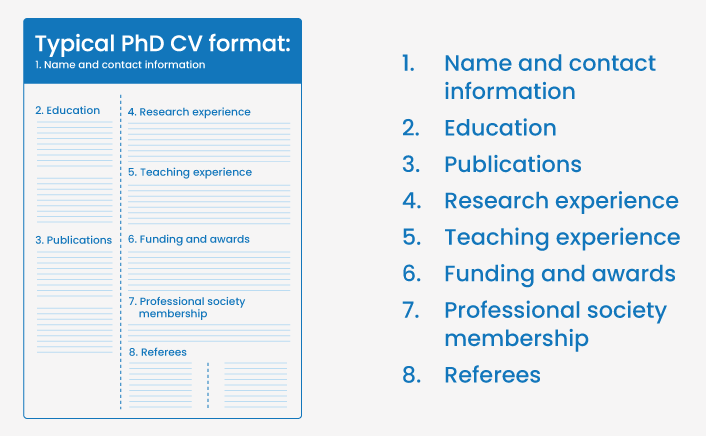
A PhD CV is a thorough representation of your scholarly journey and potential to contribute to your chosen field of study. There are some sections, similar to a standard CV, you must include in your academic PhD CV. There are also some additional sections that are unique to an academic CV. Let's have a look at both.
This should be your name — fairly large and clear, at the top of the page. It is not necessary to write “CV” or “Curriculum Vitae” – this should be obvious to the reader.
Include your contact information below this, such as your address, phone number and email.
For an academic CV, this is an important section and usually is found near the top. List by degree, plus titles, with the most advanced first (i.e. PhD, Masters, Bachelors etc.). It is acceptable to include your current degree, clearly noted.
This section is vital to show the hard skills necessary to be eligible for the position. For example, if a PhD project description states that applicants require a Masters degree, then your relevant Masters degree should be prominent here.
If useful to the application, you can include individual courses on a degree with their marks. But, give course titles and do not include course codes – these are usually just for internal administration purposes.
This section, often found at the top of your CV, should provide a brief summary of your research experience and interests. Tailor it to the specific PhD programme by addressing the project or job description directly. A well-crafted personal profile can set the tone for the rest of your CV.
As with all aspects of a PhD CV, it is better to show, not tell. Give evidence of skills, interest and enthusiasm where possible rather than just stating it outright.
If you are deeper into your academic career, and have lots of publications and research experience, you may not need this section – it should be fairly clear from your research experience.
"I have spent four years studying 18th Century History, focusing on the French Revolution. I've published several articles in renowned history journals and presented my findings at international conferences. I aim to deepen my expertise through PhD research at your esteemed institution, particularly exploring socio-political impacts of revolutionary movements."
"I’m enthusiastic about Science and I really like learning. My research interest is Physics. I’ve got undergraduate and Masters degrees in Physics, so I want to do a PhD next."
List any journal articles, books (or chapters), reports and patents in reverse chronological order. Highlight your name if you are one of many authors. This section demonstrates your ability to contribute original research to your field.
If this is a long list, it may be better suited as an appendix.
Detail all relevant research projects, including your current research. Describe the projects clearly, listing the skills and experiences gained. Mention supervisors and highlight any impressive aspects. This section is crucial as it shows your hands-on experience and technical abilities.
2017-present: Investigation into Viral Capsid Protein Self-Assembly
Masters degree research project, supervised by Prof. J. Bloggs. Acquired knowledge in molecular biology techniques and in vitro protein analysis. Presented findings at several academic conferences.
2016: Redox Sensors of Bacillus subtilis
Undergraduate research project under the supervision of Dr S. Smyth. Gained experience of protein crystallisation and bioinformatic analysis. My research report for this project was awarded a First Class mark.
Laboratory research. I have research experience in Molecular Biology laboratories at the Universities of Aberdeen and Dundee, developing relevant skills such as PCR, genetic cloning, protein purification, and protein crystallisation.
Presenting. I have presented research using a variety of techniques, including talks, posters, and workshops. These have been presented to academic experts at national conferences.
Academic writing. I have written many pieces of assessed research writing. These include literature reviews, research reports, and meta-analyses. All marks shown in Education section.
Include any teaching or mentoring roles you've undertaken, indicating the level of students and any additional responsibilities, such as planning or grading. Teaching experience is often highly valued in academic settings as it shows your ability to disseminate knowledge effectively.
List any competitive grants, scholarships, fellowships or bursaries you’ve received. This demonstrates your ability to secure competitive funding — a key skill in academia. Highlighting these achievements can significantly bolster your application.

Whether it’s your first or fifteenth academic CV, Gaia’s top tips will help you make it the best it can be.
Being actively involved in professional societies shows commitment to your field of study. Ensure you include dates of membership. Active participation in these societies can also provide networking opportunities and demonstrate your engagement with the academic community.
Always check the application requirements for the number of referees needed. Typically, provide at least two academic references who can vouch for your competence and potential. Choose referees who know your work well and can speak to your specific qualifications and achievements.
Research and teaching skills may already be included in specific sections, but this section may serve for any other relevant skills.
This can include things like administrative experience, professional development, additional training, and languages (with proficiency noted).
I like reading books. I have experience of working in a local shop. Good with animals. Can do 46 keepie-uppies in a row. . .

An academic CV is often accompanied by a PhD cover letter. This will give you the chance to expand on the experience you've laid our in your CV and fill in any gaps.
Read more about PhD cover letters.

If you are shortlisted for a PhD interview, you may be asked to discuss the contents of your CV. Therefore, you can keep the CV concise and clear, and expand later at the interview if it is relevant.
As you write your academic CV for a PhD application, there are plenty of things you should bear in mind to make sure that you give a strong impression to those reading it. These are my tips for producing a great academic CV:
Finally, always get additional advice and opinions. Not all advice is good, but you should always get help to find any mistakes or opportunities for improvement. Advice from someone who is experienced in the research field – perhaps a PhD graduate themselves – who can offer discipline-specific help on the academic CV will be particularly useful.
It’s ok if you haven’t received your final exam or dissertation results at the time of applying. Just include any results or marks you already have. Sometimes, you can even add the marks you’re expecting to finish with and update them later.
In the UK, USA and Canada, a photo should not be included. In some professions, this will cause the CV to immediately be discarded due to anti-discrimination laws. However, in some countries, for example in continental Europe, photos are often included at the top of a CV. Always check the conventions of the country you are applying to.
Whilst having publications and research experience under your belt is a massive plus, it isn’t something that is implicitly expected from PhD applicants. Include any experience you have (for example, a research project at Masters level) and show an enthusiasm for research. It could be worth changing your PhD CV to a more skills-based format. In this way, you can put more focus on transferable skills that are useful in academia, and less focus on research experience.

Head over to our PhD course listings to find the latest opportunities. You can filter by topic, keywords, location and funding available.
 Continue with Facebook
 Taru Medha
Taru joined FindAPhD as a Content Writer in 2022. She creates well-researched, thorough content for our guides and blogs, as well as short video content for our social profiles. She has a Bachelors degree in Journalism and Mass Communication from Bennett University in India and completed a Masters degree in Global Journalism from the University of Sheffield in 2021, giving her personal experience with postgraduate study as an international student.

Getting ready to apply for a PhD? Our guides explain research proposals, references and entry tests for doctoral programmes.
Read more
Understand what a successful PhD research proposal needs to include and how to go about writing one for your project application.
Read more

or
Continue with Facebook