

or
 Continue with Facebook
Looking to list your PhD opportunities? Log in here.

We're celebrating international students in the UK by supporting the #WeAreInternational campaign.
There are lots of reasons to do a PhD. You might have a passion for research and want to specialise in an area you’ve studied. You might want a step up in your career. Or you might want to make a big difference to the world in your chosen field – which is exactly why Sasi Shanmugam Senga embarked on his DPhil.
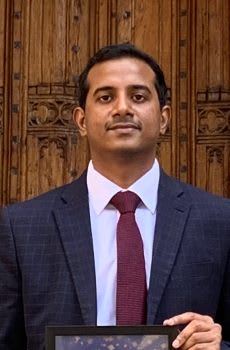
When his mother was diagnosed with cancer, Sasi knew his life's ambition was to improve cancer therapeutics for everyone.
While pursuing his DPhil in cancer research, Sasi set up the Kalavathi Cancer Foundation in his mother’s memory. The foundation supports underprivileged women and children affected by cancer in India and South Africa. He received the International Cancer Foundation award for his work and has been tipped as a 'future star' in the world of cancer research. He was also highly commended in our Postgrad Awards PhD Student of the Year category.
I am a Neurosurgical Oncologist. I completed my specialist training in cancer research at the Harvard Medical School. I then did my Masters in Neuroscience at the Australian National University. I decided to do a second Masters in Cancer and Therapeutics as a UK Commonwealth Scholar at the Barts Cancer Institute, Queen Mary University of London. Now, I’m working through my DPhil in cancer research as an Oxford Clarendon Scholar at the University of Oxford.
The most selfless and warm-hearted individual I know is my mother. She used to cook food even for strangers and supported everyone around her. Sadly, she was diagnosed with cancer and later developed brain metastases. I performed her brain surgery, but she only survived a few years after. This led me on a sacrosanct pilgrimage towards better cancer therapeutics.
During my mother’s battle against cancer, I was advised by a physician that the more money I spend, the longer she will live. I was running from pillar to post to somehow keep her alive. After her death, I decided to support the underprivileged women and children affected by cancer and started the Kalavathi Cancer Foundation.
The Kalavathi Cancer Foundation focuses on prevention with screenings, vaccinations, awareness marathons and treatment. It also supports the education of underprivileged children.
FindAPhD made it easy for me to compare the various opportunities to make an informed decision. I could narrow the search results based on international funding, and appreciated the brief project descriptions.
I’m focused more on studying literature to come up with novel ideas. I also plan and work on experiments and teach medical students. Later in the day I submit abstracts, do writing and then wind down the day with piano.
My PhD journey has made me realise that my understanding of cancer as a surgeon is a drop in the ocean. I enjoy sailing through the sea of heterogeneity to further my understanding of cancer as a disease.
The lack of support or motivation for early-stage researchers is certainly challenging given the importance in academia to an individual’s citations. These are not actual human lives and there is more to be done to support young researchers.
Three months after my mother’s death, I received the UK Commonwealth Scholarship. It is the most important award I received as a pat on the back to move forward. I was then able to study my Masters in Cancer and Therapeutics.
I plan to expand the operations of the Kalavathi Cancer Foundation to other countries outside of India and South Africa. I look forward to being a neurosurgical oncologist donning a scientist hat. Every life I touch through some novel contribution will mean my mother’s happiness.
My advice would be to go for a supervisor who suits you rather than who is dominant in the field. I'd also compare the number of publications from a lab with the number of lab members to see how many actually get published, and never compromise what your inner calling is when it comes to a project.
PhD study, for free? – 14 countries that charge very little (or nothing!) for doctoral degrees
Is it possible to study a PhD for free? We've taken a look at some of the countries with the lowest fees for doctoral students - and explained what 'studying a PhD for free' actually means.

A prospective PhD student's guide to the Research Excellence Framework
Results of the 2021 Research Excellence Framework have just been released. What exactly is the REF, and how can prospective PhD students use it?

The Top 5 universities in Germany for postgraduate study
Considering studying abroad in Germany? From Munich to Berlin, using the world rankings we've taken a look at Germany's best universities for Masters and PhD study.

or
Continue with Facebook