
or
 Continue with Facebook
Looking to list your PhD opportunities? Log in here.
Written by Hannah Slack
At some point, every PhD student has to face the abstract. Whether it’s for a conference paper, journal article or your thesis, this short paragraph carries more weight than its size suggests. It might look simple, but writing a good one takes time, skill and a fair bit of patience.
In this guide, we’ll look at what a dissertation abstract is, why it matters and how to write one that actually makes sense without turning into a mini thesis of its own.
An academic abstract is a short and concise summary of research. It should cover the aim or research question of your work, your methodology, results and the wider implications of your conclusions. All this needs to be covered in around 200-300 words.
One of the common mistakes people make when writing abstracts is not understanding their purpose. An abstract is not for the author, it’s for the reader. To summarise your research, as the person who knows it best, may seem easy. But to be able to communicate the complexities and importance of your work to someone else, likely outside of your field, can be difficult.
There are many different places that you’ll find abstracts. Some of the most common ones include:
This guide primarily focuses on the dissertation abstract, which is the most common form of this kind of text.
The main differences between a PhD dissertation abstract and an introduction are the purpose and the length. An abstract is a short, paragraph-sized summary of the whole thesis, covering context, your research and results. Whereas an introduction should be much longer and only cover the context of your work. An introduction is designed to explain the background of your work and so will take up at least an entire page.
Abstracts are important because they are a quick and easy way to communicate your work. In many ways, academic abstracts are a promotional tool and so should be considered carefully.
For your thesis, it’s the first thing your examiners will read, forming their expectations for the rest of the dissertation.
In journal articles, their purpose is to convince the reader that they should read your article. If you’re applying for a conference, the abstract gives the organiser a taster of your paper so they can decide whether it’s suitable.
Effectively, your abstract is the first impression someone gets of your research and so it’s important to put your best foot forward.
How you write a dissertation abstract will largely depend on what it’s for. For a PhD dissertation or journal article, you should have already written up the research which the abstract will summarise. You should focus on making sure your summary is an honest representation of the larger written work. However, for a conference application it’s likely you won’t yet have written the paper. In this instance, the abstract might focus more on the broader themes you intend to comment on and your methodology.
Whatever the intended purpose, all abstracts should broadly follow the same structure. To help you, we’ve put together a template to make sure you include all the important points.
Because a lot of information needs to be packed into a short paragraph, an abstract is easier to write when you break it down into the key elements. For a first draft, spend a few minutes on each of the six steps, only writing down one or two sentences.
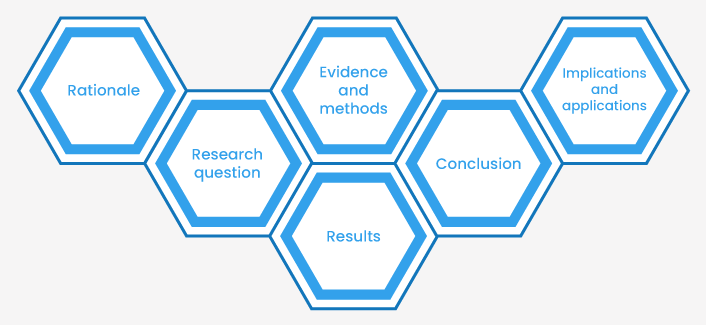
Once you have your framework it can be edited for a more natural flow. You may find that some points naturally merge into one sentence and others need some elaboration. But remember, the abstract must be short and concise so don’t be tempted to extend areas unnecessarily. Once you have a draft that you are happy with, consider asking for feedback from other PhD students or your supervisor.

For more information on trhe different stages of a doctorate, check out our guide to the PhD journey.

Search our project listings to find out what you could be studying.
 Hannah Slack
Hannah worked at FindAPhD as a Content Writer from 2020 to 2023. She started with us part-time whilst studying for her PhD, giving her personal experience with balancing work responsibilities with academia. Hannah has a Bachelor’s degree in History from the University of East Anglia, and both a Masters in Early Modern History and a PhD on Early Modern English seafarers from the University of Sheffield.

What happens during a typical PhD, and when? We've summarised the main milestones of your PhD journey to show you how to get a PhD.
Read more
The PhD thesis is the most important part of a doctoral degree. This page will introduce you to what you need to know about the PhD dissertation.
Read more
This page will give you an idea of what to expect from your routine as a PhD student, explaining how your daily life will look at you progress through a doctoral degree.
Read more
PhD fees can vary based on subject, university and location. Use our guide to find out the PhD fees in the UK, as well as doctoral living costs.
Read more
Our guide tells you everything about the application process for studying a PhD in the USA.
Read more
A quick guide to post-study work visas in top countries so you know where you can stay and work after graduation.
Read more

or
Continue with Facebook